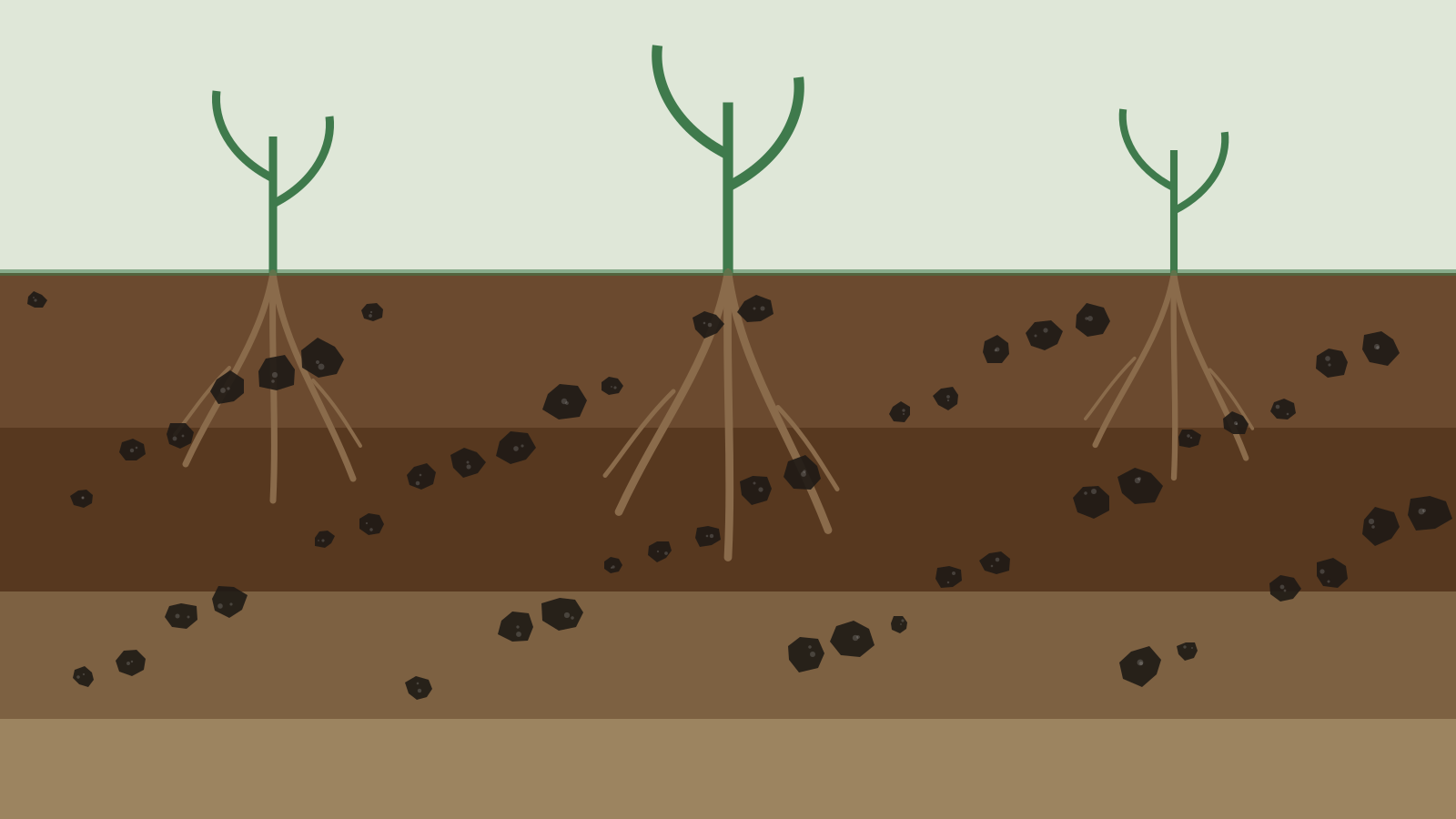
Biochar does not feed plants directly. It contains few nutrients that plants can use straight away. Instead, it changes the environment that roots and microbes live in, and that environment keeps improving for years. Here is how it works, step by step.
It starts with structure
Biochar keeps the cellular skeleton of the plant it was made from. Its pores range from wide channels left by the plant's water-conducting vessels down to nanometre-scale pores created as the carbon rearranges during pyrolysis. This gives biochar a very large internal surface for its weight, and a range of pore sizes that each do a different job: the largest let air and water move and give fungi a place to grow; the medium ones hold water; the smallest give nutrients and organic molecules a surface to stick to.
Biochar is also very light. Mixed into soil, it lowers bulk density, making compacted or heavy soils more open and easier for roots to penetrate.
A water sponge
Water clings to surfaces and is held in small pores by capillary forces. Biochar adds both. In sandy soils, which have large pores that let water drain straight through, biochar fills in the missing middle range of pore sizes and increases the amount of water the soil can hold against gravity. A systematic review found the clearest gains in coarse-textured soils. In clay soils, biochar's main effect is often the opposite: it opens up the soil, improving drainage and aeration.
A nutrient reservoir
Fresh biochar surfaces carry relatively few charged sites. Over time in soil, as its surfaces oxidise and become coated with organic matter, biochar develops a strong negative charge, increasing its cation exchange capacity: its ability to hold positively charged nutrients such as potassium, calcium, magnesium and ammonium and release them to roots. This is one reason the old biochar in Amazonian dark earths holds nutrients so well, and why biochar's benefits often grow over the first few seasons.
Research published in Nature Communications showed that the key is an organic coating that forms on biochar's surfaces in soil and, much faster, in compost. This thin layer of organic compounds holds nutrients and water and helps explain why co-composted biochar works so well.
Capturing nitrate
Nitrate is the form of nitrogen plants take up most, and also the form most easily washed out of soil, because it is negatively charged and slips past most soil particles. Co-composted biochar can capture nitrate inside its pores. One study found that this captured nitrate is released slowly to plants and accounted for much of the growth improvement seen with co-composted biochar. Studies across many sites show that biochar reduces nitrate leaching and emissions of nitrous oxide.
A home for microbes
For soil bacteria and fungi, biochar pores are protected habitat: shelter from drying, from temperature swings and from the protozoa and nematodes that graze on them. Biochar surfaces also adsorb organic compounds and nutrients that microbes feed on. The result is usually more microbial activity around biochar particles and changes in which microbes are present, often including more of the mycorrhizal fungi that partner with plant roots and extend their reach for water and phosphorus.
Changing soil chemistry
Most biochar is alkaline and carries mineral ash. In acidic soils it raises pH, which reduces aluminium toxicity and makes phosphorus and other nutrients more available. Its surfaces can also bind some pollutants, including certain pesticides and heavy metals, reducing how much plants take up. These effects depend on the biochar: feedstock and production temperature determine its pH, ash content and surface chemistry.
It builds more carbon, not just stores it
Biochar does not just add its own carbon. A ten-year field study published in Nature Climate Change found that biochar also helped soil build and keep new organic carbon from plant roots, by stabilising root-derived organic matter on mineral and biochar surfaces. A meta-analysis of decomposition studies found that biochar generally causes only a small and short-lived increase in the breakdown of existing soil organic matter, and in some soils reduces it. Over time, biochar-amended soils tend to hold more total carbon than biochar alone would explain.
Why charging matters
Because fresh biochar has an empty, highly absorbent surface, it can temporarily take up nitrogen and water before it starts giving them back. In the field this can show up as slower early growth after a heavy dose of raw biochar. Charging solves this: mixing biochar into compost during composting, soaking it in diluted urine, manure slurry or liquid fertilizer, or using a ready-made product such as biochar-enriched compost. A charged biochar arrives with its surfaces already loaded and its organic coating already forming.
What this means in practice
Biochar works through slow, physical and biological changes, not like a fertilizer that acts in days. Expect its effects to build over the first two to three seasons. Use it charged, at moderate rates, alongside good nutrient management. The soils that benefit most are those with the most room to improve: sandy, acidic, compacted or low in organic carbon.
In short, think of biochar as an investment in the soil itself rather than an input for a single crop. Its job is to make every other input, from water to compost to fertilizer, work harder for longer, and that effect accumulates season after season.
How biochar changes as it ages
Biochar in soil is not static. In its first months, its surfaces oxidise on contact with air and water, gaining oxygen-containing groups that carry a negative charge. Organic molecules from roots, microbes and decomposing residues coat its pores. Fine mineral particles attach to its surfaces, and fungal threads grow through it. Each of these changes increases its ability to hold nutrients and water and binds it more firmly into soil aggregates.
This is why studies that follow biochar for several years often find its benefits growing rather than fading, and why centuries-old charcoal in Amazonian dark earths is among the most nutrient-retentive material in those soils. A small fraction of the biochar does decompose in the first years, mostly its less stable, lower-temperature components, but the bulk remains.
Different soils, different effects
Because biochar works through soil structure, chemistry and biology, its effect depends on the soil it goes into. In sandy and red soils, the main gain is water and nutrient holding. In acidic laterite soils, the liming effect and the extra nutrient-holding capacity matter most. In heavy black cotton soils, biochar mainly improves aeration and workability, and an alkaline biochar may be less suitable where the soil pH is already high. In saline soils, biochar can help by improving drainage and binding some sodium, though managing salinity still depends on drainage and good-quality water. Knowing your soil type and pH is the first step in deciding how to use biochar.
Particle size and placement
How biochar is applied changes how it works. Fine particles mix intimately with soil and present the most surface, which suits nutrient retention and compost blending. Coarser particles keep larger pores open, which helps drainage and aeration in heavy soils. Biochar works where roots are, so it is most effective worked into the topsoil or placed in planting rows and pits; left on the surface it can be blown or washed away.
Sources and further reading
Lehmann, J. & Joseph, S. (eds.) (2015). Biochar for Environmental Management: Science, Technology and Implementation, 2nd edition. Routledge.
Hagemann, N., Joseph, S., Schmidt, H.-P. et al. (2017). Organic coating on biochar explains its nutrient retention and stimulation of soil fertility. Nature Communications 8, 1089.
Kammann, C. I., Schmidt, H.-P., Messerschmidt, N. et al. (2015). Plant growth improvement mediated by nitrate capture in co-composted biochar. Scientific Reports 5, 11080.
Razzaghi, F., Obour, P. B. & Arthur, E. (2020). Does biochar improve soil water retention? A systematic review and meta-analysis. Geoderma 361, 114055.
Borchard, N., Schirrmann, M., Cayuela, M. L. et al. (2019). Biochar, soil and land-use interactions that reduce nitrate leaching and N2O emissions: a meta-analysis. Science of the Total Environment 651, 2354–2364.
Weng, Z., Van Zwieten, L., Singh, B. P. et al. (2017). Biochar built soil carbon over a decade by stabilizing rhizodeposits. Nature Climate Change 7, 371–376.
Wang, J., Xiong, Z. & Kuzyakov, Y. (2016). Biochar stability in soil: meta-analysis of decomposition and priming effects. GCB Bioenergy 8, 512–523.
Sourcing biochar in bulk?
Talk to our team about grades, volumes and export.