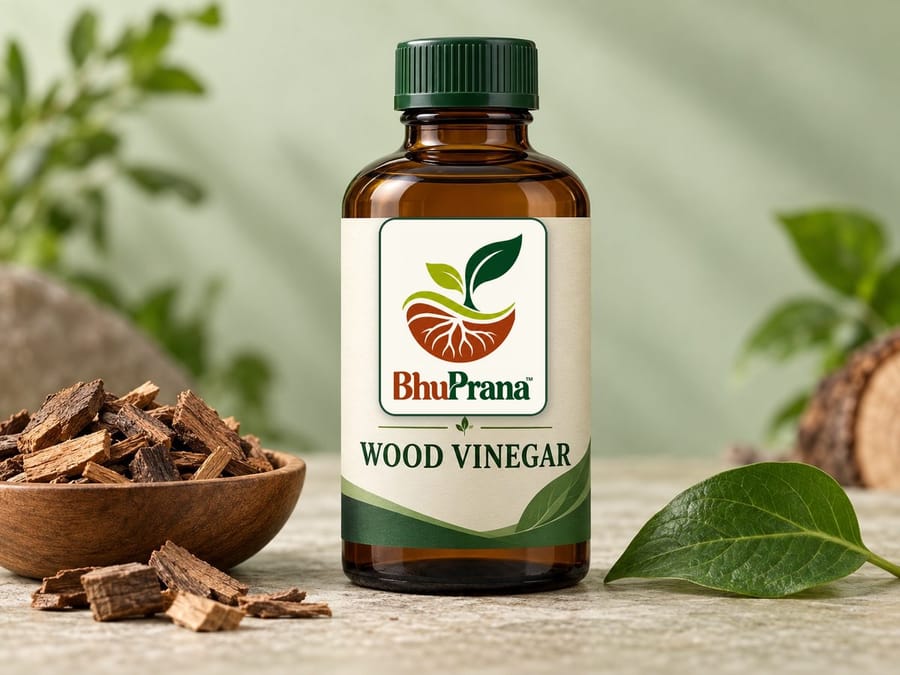
Wood Vinegar
Wood vinegar (pyroligneous acid) is a refined condensate from pyrolysis, valued in organic agriculture as a natural bio-stimulant, soil conditioner and pest deterrent. It supports plant vigour without synthetic chemistry.
check_circle Key Benefits
Applications
Industries Served
Specifications
Packaging
1 L and 5 L bottles for distributors; 200 L drums for bulk. Private-label options available.
Bulk Supply
Bulk and distributor volumes on contract for organic input brands and agri-retailers.
What wood vinegar is
Wood vinegar, or pyroligneous acid, is collected when the smoke and vapours from pyrolysis are cooled and condensed. The raw liquid is left to settle so that tars separate out, and the clear amber layer is refined for use. It is a complex mixture of water, acetic acid and a large number of organic compounds, including phenols, alcohols and esters, which gives it its smoky smell.
Farmers in Japan, Korea and South-East Asia have used it for decades, and research interest has grown in recent years.
How growers use it
Wood vinegar is used in very dilute form. In agriculture it is applied as a foliar spray to support plant growth and vigour, as a soil drench to stimulate soil biology, as an additive to compost heaps to speed decomposition and reduce odour, and as a seed soak. Its strong smell and acidity also make it a traditional deterrent for some insects and pests. A scientific review of its agricultural uses reported positive effects on seed germination, plant growth and yield in a number of studies, while noting that results depend heavily on the dilution and the crop.
Dilution and application
Never apply wood vinegar undiluted: it is acidic and can scorch leaves and roots. For foliar sprays, growers commonly use dilutions between about 1 : 200 and 1 : 500 in water, sprayed in the early morning or late evening. For soil drenching and compost, stronger dilutions are used, such as 1 : 50 to 1 : 100. Always test a new dilution on a few plants first and watch for leaf damage over two or three days before treating a whole crop. Do not mix it with alkaline products such as lime sulphur.
Combining with biochar
Wood vinegar and biochar come from the same process and work well together. Soaking biochar in diluted wood vinegar before it goes into compost or soil is one way growers charge it with organic compounds and stimulate early microbial activity.
Storage and handling
Store bottles and drums sealed, upright and out of direct sunlight. Wear gloves and eye protection when handling the concentrate, and keep it out of reach of children and animals.
Packaging and supply
Supplied in 1 litre and 5 litre bottles for distributors and retail, and 200 litre drums for bulk users. Private-label options are available for organic input brands and agri-retailers.
Sources and further reading
Grewal, A., Abbey, L. & Gunupuru, L. R. (2018). Production, prospects and potential application of pyroligneous acid in agriculture. Journal of Analytical and Applied Pyrolysis 135, 152–159.
Frequently asked questions
How do I dilute wood vinegar for a foliar spray?
Growers commonly use about 1 : 200 to 1 : 500 in water. Test a new dilution on a few plants first, and spray in the early morning or evening.
Can wood vinegar be used undiluted?
No. The concentrate is acidic and can scorch leaves and roots. Always dilute it before use.
Is wood vinegar a pesticide?
It is used as a natural deterrent for some pests because of its smell and acidity, but it is not a registered pesticide and should not be relied on as one.
Is wood vinegar suitable for organic farming?
It is a natural product of biomass pyrolysis. If your farm is certified, check with your certification body before using any new input.