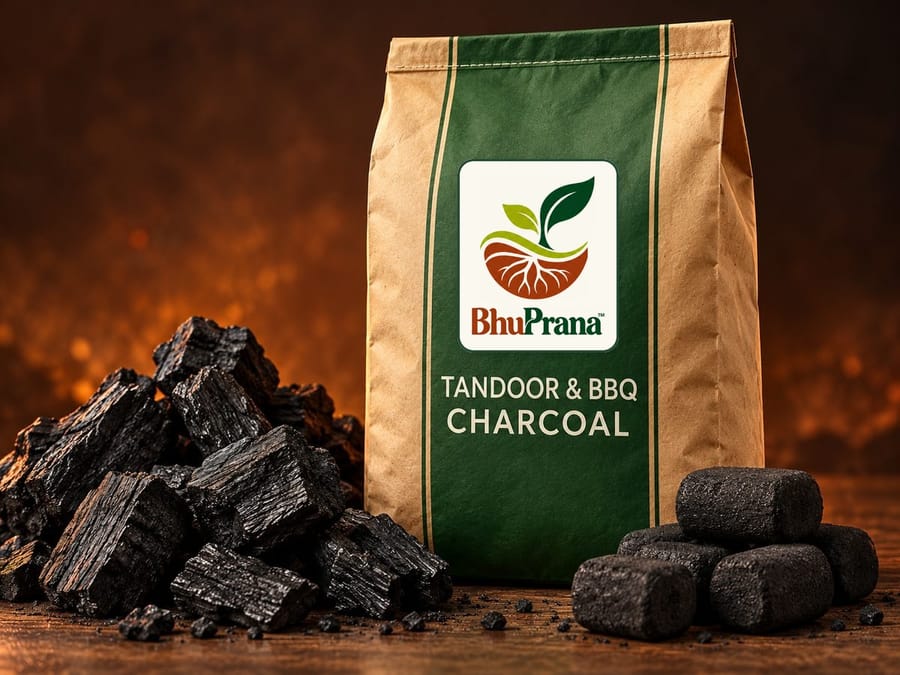
Tandoor & BBQ Charcoal
Domestic-grade charcoal for tandoors, grills and barbecue. Made from dense Juliflora, it lights readily, burns hot and steady, and produces minimal smoke and ash — ideal for restaurants, caterers and retail.
check_circle Key Benefits
Applications
Industries Served
Specifications
Packaging
2 kg, 5 kg and 20 kg bags; bulk loose for HORECA buyers.
Bulk Supply
Regional distribution and bulk HORECA supply. Custom bagging available.
Made for steady, high heat
Our Tandoor & BBQ Charcoal is made from dense Prosopis Juliflora wood, carbonised in the same controlled process as our biochar. Dense hardwood gives a charcoal that lights readily, burns hot and lasts a long time in the pot or grill, with a fixed carbon content of 65–72% and moisture below 8%. Low moisture is what keeps smoke and sparks down once the charcoal is lit.
This line is launching soon. Restaurants, caterers and distributors can register now for samples and first supply.
A better use for an invasive tree
Prosopis Juliflora, known in Tamil Nadu as seemai karuvelam, has spread across dry land and water bodies, lowering groundwater and crowding out native plants, and clearing it is a long-running public priority. Much of the cleared wood has traditionally gone into small earth kilns that release heavy smoke. Carbonising it in a controlled plant instead gives a cleaner, more consistent charcoal and puts the cleared wood to good use.
Lump or briquette
Lump charcoal is the carbonised wood itself, in natural irregular pieces. It lights fast and reaches high temperatures quickly, which suits tandoors, sigris and high-heat grilling. Briquettes are made from charcoal fines pressed into a uniform shape; they burn more evenly and for longer, which suits long cooking sessions and slow barbecue. Many kitchens use both: lump to reach temperature, briquettes to hold it.
Lighting and use
Stack the charcoal loosely so air can move through it, and light it with a chimney starter, paper and kindling or a natural fire starter. Avoid kerosene and petrol, which taint food and are dangerous. The charcoal is ready to cook on when the flames have died down and the pieces are covered in a thin layer of grey ash, usually after 15–25 minutes. In a tandoor, build the fire well before service so the clay walls reach temperature.
Safety
Burning charcoal produces carbon monoxide, which has no smell and can kill. Only use charcoal outdoors or in a kitchen with proper ventilation and an extraction hood, never in a closed room, tent or vehicle. Let ash cool completely, for at least 48 hours or by soaking it in water, before disposal.
Storage
Charcoal absorbs moisture from the air, and damp charcoal lights badly and smokes. Keep bags sealed, off the floor and in a dry place away from heat sources.
Packaging and supply
Packed in 2 kg, 5 kg and 20 kg bags, with bulk loose supply for hotels, restaurants and caterers. Custom bagging and private label are available for distributors.
Frequently asked questions
Is this charcoal good for tandoors?
Yes. Dense lump charcoal from Prosopis Juliflora burns hot and steady, which is what a clay tandoor needs to reach and hold temperature.
How long does it take before I can start cooking?
Usually 15–25 minutes, once the flames have died down and the pieces are covered in a thin layer of grey ash.
Can I use charcoal indoors?
Only in a commercial kitchen with proper ventilation and an extraction hood. Burning charcoal produces carbon monoxide, which is odourless and dangerous in enclosed spaces.
When will Tandoor and BBQ Charcoal be available?
The line is launching soon. Send an enquiry to register for samples and first supply.