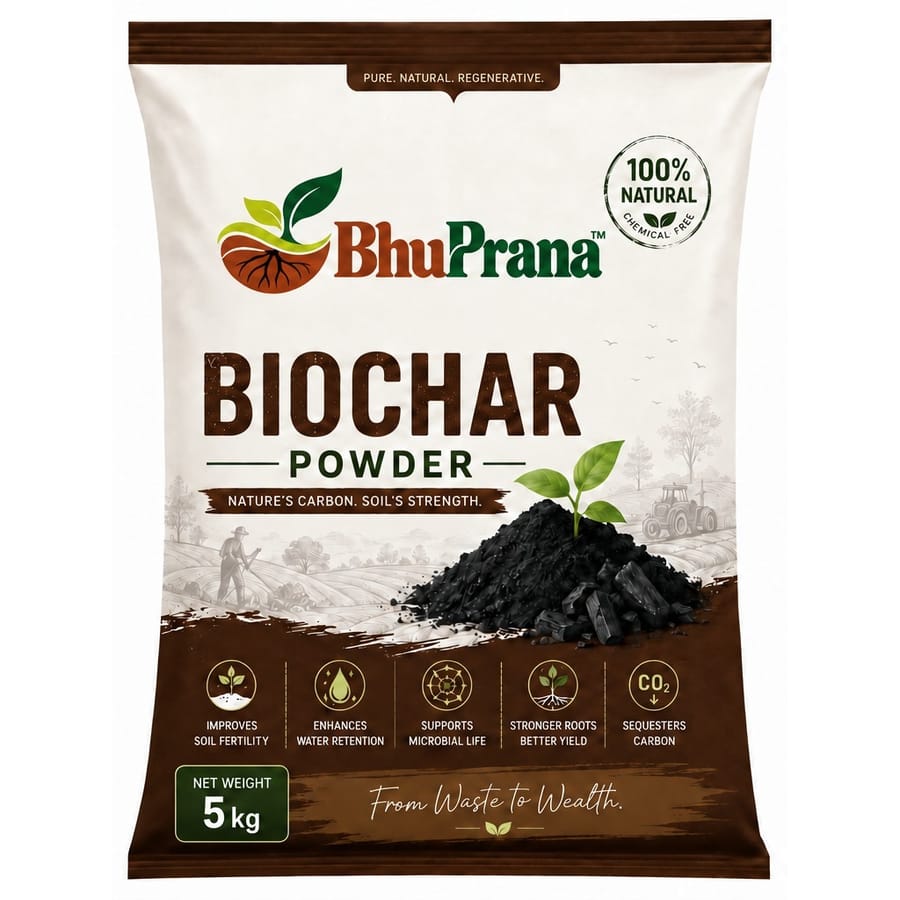
Premium Graded Biochar
Our flagship biochar is produced from Prosopis Juliflora via continuous rotating-drum pyrolysis, then screened into consistent particle grades. With 68–72% fixed carbon and a stable porous structure, it is engineered to hold water, host microbes and lock carbon in soil for centuries.
check_circle Key Benefits
Applications
Industries Served
Specifications
Packaging
Small packs: 1 kg, 2 kg, 5 kg and 10 kg. Bulk supply: 25 kg and 50 kg bags. Custom private-label packaging available.
Bulk Supply
Minimum bulk order from 5 tons. Pan-India dispatch and containerised export (coconut shell biochar) to Oman and Sri Lanka.
How it is made
Premium Graded Biochar starts as Prosopis Juliflora, the invasive thorn tree known in Tamil Nadu as seemai karuvelam, supplemented with agricultural residue and wood waste. The biomass is dried and fed through a continuous rotating-drum reactor at 350–550°C with no oxygen, so it chars instead of burning. The gases released along the way are recovered and burned to heat the dryer and reactor, which keeps fuel use down.
Once cooled, the char is screened into consistent particle grades. Screening is what makes biochar predictable in use: a fine grade spreads evenly through compost or potting media, a coarser grade holds its structure in filters, beds and field soils. Every batch is tested for fixed carbon, ash, moisture and bulk density before it ships, and a certificate of analysis travels with each dispatch.
Choosing a grade
0–2 mm is the grade most buyers use for compost co-blending, potting mixes, seed-starting media and fertilizer granulation, because it mixes evenly and has the most exposed surface. 2–8 mm suits field application where you want the char to keep an open structure, raised beds, turf and landscaping, and filtration or odour beds where water and air have to pass through. Custom screening is available for larger orders, including dust-reduced cuts for bagging lines.
Charge it before it goes into soil
Fresh biochar is clean carbon with an enormous internal surface. Put straight into soil, it can hold on to some nitrogen and water for the first weeks before it gives anything back. The fix is to charge it first: mix it into compost while the heap is active, soak it in diluted manure slurry, jeevamrut or liquid fertilizer for one to two weeks, or blend it with vermicompost. Research on co-composted biochar shows that the organic coating it picks up during composting is a large part of why it holds and releases nutrients so well.
If you do not want to charge biochar yourself, our Biochar-Enriched Compost (BEC) is pre-charged and ready to apply.
How much to use
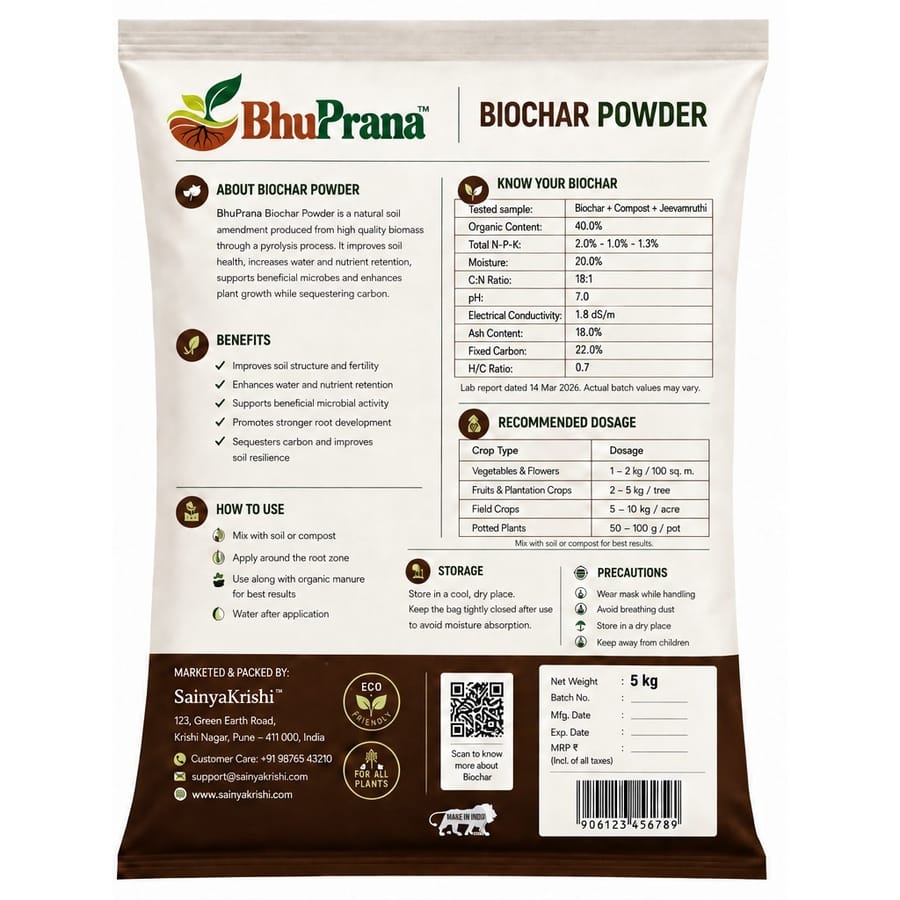
Field trials around the world have used a wide range of rates, from under one ton to more than ten tons per hectare. For charged biochar on Indian farms, a common starting point is 0.5–2 tons per acre, worked into the top 10–15 cm of soil before sowing. Because biochar persists for centuries, the effect builds: many growers apply a moderate rate over two or three seasons rather than one heavy dose. In potting media, 5–20% biochar by volume is a typical range. Our team can suggest a rate for your crop, soil and budget; share a soil test if you have one.
Handling and storage
Biochar is light and dusty when dry. Moisten it slightly before tipping or spreading, work with the wind behind you, and wear a dust mask for large volumes. Store bags dry, off the floor and away from open flames. Kept dry, biochar does not degrade: it can be stored indefinitely.
Packaging and supply
Small packs of 1, 2, 5 and 10 kg are sold under our BhuPrana brand for retail and trials. Bulk orders ship in 25 kg and 50 kg bags, with private-label packaging available. Bulk orders start from 5 tons, with dispatch across India; for export, we supply coconut shell biochar in containers to Oman and Sri Lanka.
Sources and further reading
Lehmann, J. & Joseph, S. (eds.) (2015). Biochar for Environmental Management: Science, Technology and Implementation, 2nd edition. Routledge.
Hagemann, N., Joseph, S., Schmidt, H.-P. et al. (2017). Organic coating on biochar explains its nutrient retention and stimulation of soil fertility. Nature Communications 8, 1089.
Kammann, C. I., Schmidt, H.-P., Messerschmidt, N. et al. (2015). Plant growth improvement mediated by nitrate capture in co-composted biochar. Scientific Reports 5, 11080.
Jeffery, S., Abalos, D., Prodana, M. et al. (2017). Biochar boosts tropical but not temperate crop yields. Environmental Research Letters 12, 053001.
European Biochar Certificate (EBC): Guidelines for a sustainable production of biochar. Carbon Standards International.
International Biochar Initiative: Standardized Product Definition and Product Testing Guidelines for Biochar That Is Used in Soil (IBI Biochar Standards).
Frequently asked questions
What is the difference between biochar and charcoal?
Both are made by heating biomass without oxygen, but biochar is made and graded for use in soil and the environment, not as fuel. It is produced under controlled conditions, tested for carbon, ash and contaminants, and screened to a particle size that suits its use.
Which particle grade should I order?
0–2 mm for compost, potting mixes and fertilizer blending; 2–8 mm for field application, landscaping and filtration. We can screen custom grades for larger orders.
Can I apply raw biochar directly to my field?
You can, but it works better charged first: mix it into compost, soak it in diluted manure or liquid fertilizer for one to two weeks, or use our ready-charged BEC. Raw biochar can hold back some nitrogen in the first weeks.
How long does biochar last in soil?
Studies of biochar decomposition put its average residence time in soil in the hundreds of years, and the most stable fraction lasts far longer. You do not need to reapply it every season the way you do compost.
What is the minimum order for bulk biochar?
Bulk orders start from 5 tons. Small packs from 1 kg to 10 kg are available for trials and retail.
Does every batch come with a lab report?
Yes. Every batch is tested for fixed carbon, ash, moisture and bulk density, and a certificate of analysis accompanies every dispatch.