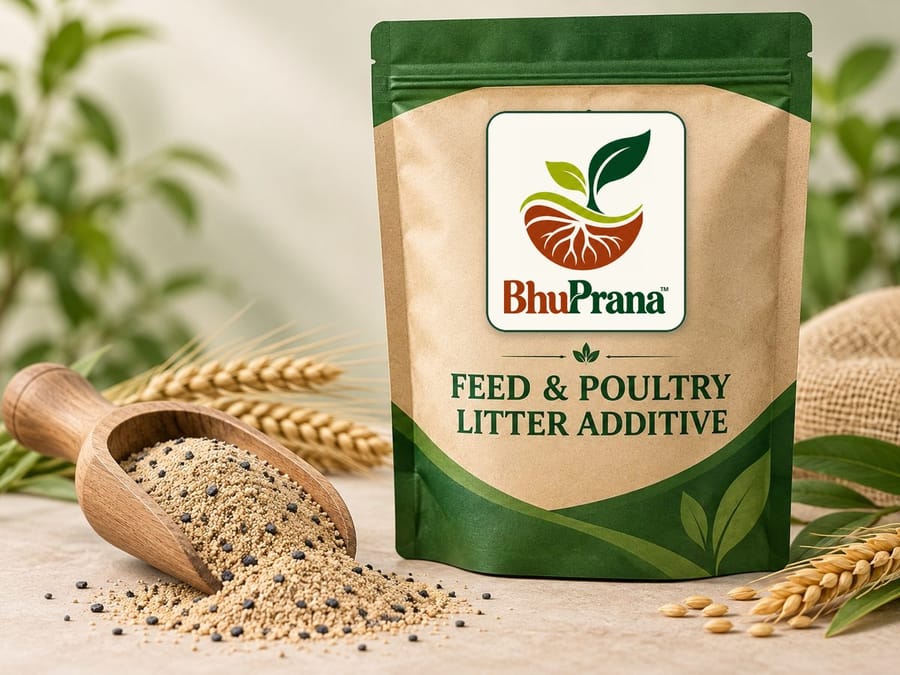
Feed & Poultry Litter Additive
A fine, food-safe grade of biochar for use as a livestock feed supplement and poultry-litter amendment. Peer-reviewed studies link biochar feed additives to improved feed conversion, reduced enteric methane and better odour and moisture control in litter — an underserved opportunity given India’s dairy and poultry scale.
check_circle Key Benefits
Applications
Industries Served
Specifications
Packaging
25 kg bags and jumbo bags; distributor packs available.
Bulk Supply
Bulk supply for feed mills, dairies and poultry integrators.
Biochar in feed and bedding
Farmers have fed charcoal to animals for centuries, and modern research has started to explain why. A review of more than a hundred studies on biochar in animal feeding reported that most found positive effects on measures such as weight gain, feed efficiency, toxin binding and gut health, while noting that results vary with the biochar, the dose and the animal. Several studies have also reported lower methane emissions from cattle, though this is not yet consistent across trials.
Our Feed & Poultry Litter Additive is a fine grade of our biochar, produced for these uses.
In poultry litter
Mixed into poultry bedding, biochar absorbs moisture and binds ammonia, the main source of the sharp smell in sheds. Drier, lower-ammonia litter is better for birds' respiratory health and footpads, and makes the shed a better place to work. When the litter is cleaned out, the biochar goes with it to the field, where it improves the manure as a fertilizer and helps hold its nitrogen in the soil.
A common approach is to scatter the additive over fresh bedding and top it up between batches, at a rate agreed with your integrator or farm adviser.
In feed
As a feed ingredient, biochar is used at low inclusion rates. Most feeding trials have used around 1% of the daily feed dry matter or less. The right rate depends on the species, the age of the animals and the rest of the ration, so set it with your veterinarian or animal nutritionist, introduce it gradually, and keep records of performance.
Feed use requires a clean, feed-grade material. Ask us for the certificate of analysis for your batch, and check the rules on feed ingredients that apply to your farm or market.
In manure and slurry
Biochar added to manure heaps and slurry pits reduces odour and nitrogen loss and turns the manure into a better soil amendment. Biochar that has passed through an animal and its bedding is fully charged with nutrients and microbes by the time it reaches the soil.
Packaging and supply
Supplied in 25 kg bags and jumbo bags, with distributor packs available. We supply feed mills, dairies, poultry integrators and distributors on volume contracts.
Sources and further reading
Schmidt, H.-P., Hagemann, N., Draper, K. & Kammann, C. (2019). The use of biochar in animal feeding. PeerJ 7, e7373.
Schmidt, H.-P., Kammann, C., Hagemann, N. et al. (2021). Biochar in agriculture: a systematic review of 26 global meta-analyses. GCB Bioenergy 13, 1708–1730.
Frequently asked questions
How much biochar can be added to animal feed?
Most feeding trials have used around 1% of daily feed dry matter or less. Set the rate with your veterinarian or nutritionist and introduce it gradually.
How does biochar reduce smell in poultry sheds?
It absorbs moisture and binds ammonia in the litter, the main cause of odour, which also improves air quality for the birds.
Does biochar reduce methane from cattle?
Some studies have reported lower methane emissions, but results are not yet consistent across trials. Improved feed efficiency and gut health are the more widely reported effects.
What happens to the biochar after the litter is cleaned out?
It goes to the field with the manure, where it helps hold nutrients and water in the soil and keeps storing carbon for the long term.