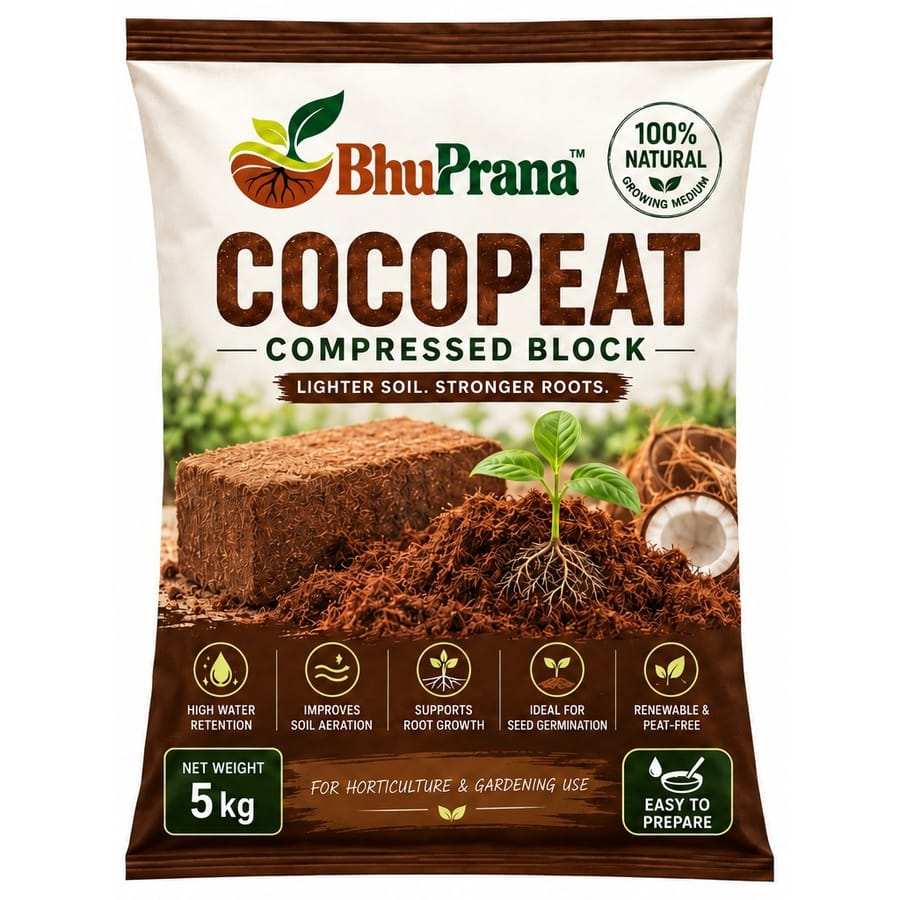
Cocopeat
Cocopeat is the fine pith left when coconut husk is processed for coir. Washed to a low EC, dried and compressed into blocks, it expands with water into a light, uniform medium that holds several times its own weight in water while staying airy around the roots. A renewable alternative to peat moss, it is a staple for seed germination, nursery potting mixes and soilless growing — and pairs naturally with biochar in our custom blends.
check_circle Key Benefits
Applications
Industries Served
Specifications
Packaging
Small packs: 1 kg, 2 kg, 5 kg and 10 kg. Bulk supply: 25 kg and 50 kg bags. Soak a block in water to expand it before use.
Bulk Supply
Bulk supply for nurseries, greenhouses, landscapers, blend makers and distributors.
What cocopeat is
Cocopeat, also called coir pith, is the spongy material left when coconut husks are processed for their fibre. It was once a waste product; today it is one of the most widely used growing media in the world. It is washed to bring down the natural salts, dried, and pressed into blocks that are easy to store and ship.
Its value lies in its structure. Cocopeat holds several times its own weight in water while keeping plenty of air space, so roots stay moist without becoming waterlogged. Studies comparing coir dust with peat found it a workable peat substitute for container plants once its salt content is controlled.
Why low EC matters
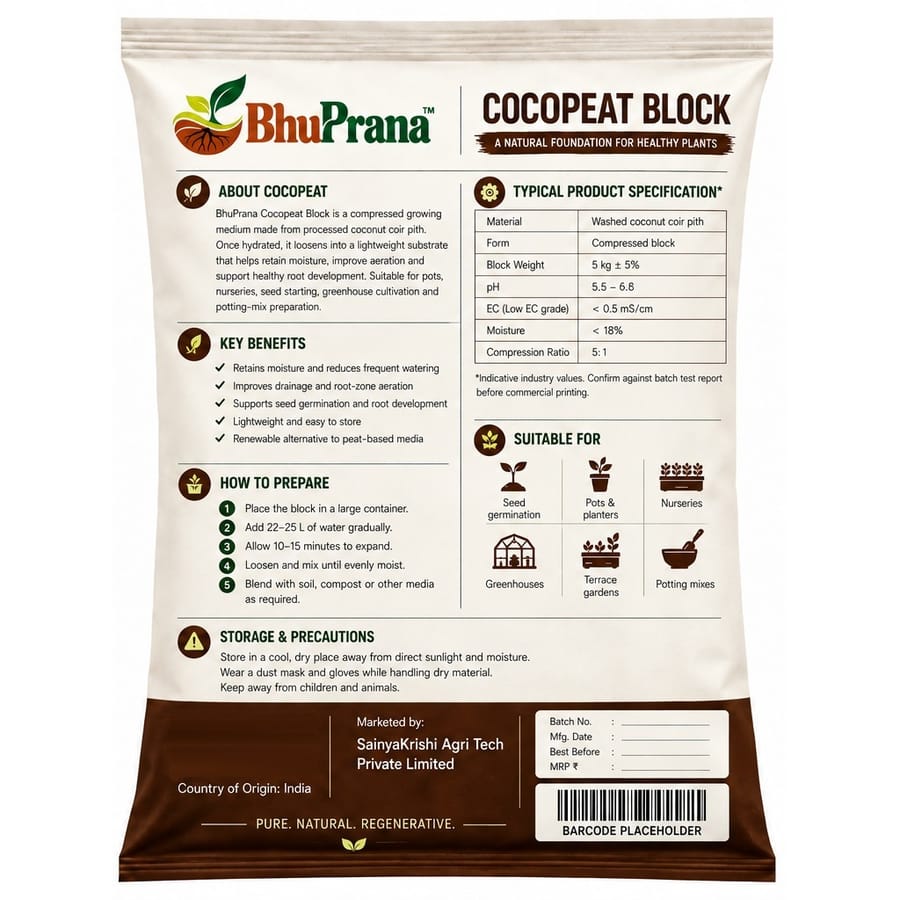
Electrical conductivity (EC) measures the soluble salts in a growing medium. Unwashed coir can carry enough sodium and potassium to burn seedlings and cuttings. Our cocopeat is washed to an EC below 0.5 mS/cm, low enough for germination trays and sensitive nurseries without further rinsing. The pH sits between 5.5 and 6.8, which suits most crops.
How to expand a block
Place the block in a tub or wheelbarrow with room to swell, and add water a little at a time, roughly 4–5 litres per kilogram of block. Leave it for 20–30 minutes, then break it up by hand until it is loose and evenly moist. Because the block is compressed about 5 : 1, it expands to several times its packed volume. Squeeze a handful: a few drops of water is right; a stream means it is too wet, so let it drain before use.
Ways to use it
For seed trays and plug nurseries, cocopeat can be used on its own or with a little vermicompost. For potting mixes, a common starting point is equal parts cocopeat, compost and soil or sand. For terrace gardens and grow bags, cocopeat keeps containers light, which matters on rooftops. In soilless and greenhouse production it serves as a substrate fed with nutrient solution.
Cocopeat has very few nutrients of its own, so plants grown in it need feeding. It also pairs well with biochar: a small share of biochar in a coir mix adds a long-lasting home for microbes and helps buffer nutrients. That combination is the base of our custom soil blends.
Packaging and supply
Small packs of 1, 2, 5 and 10 kg are sold under our BhuPrana brand. Bulk supply ships in 25 kg and 50 kg bags for nurseries, greenhouses, landscapers, blend makers and distributors.
Sources and further reading
Abad, M., Noguera, P., Puchades, R., Maquieira, A. & Noguera, V. (2002). Physico-chemical and chemical properties of some coconut coir dusts for use as a peat substitute for containerised ornamental plants. Bioresource Technology 82, 241–245.
Lehmann, J. & Joseph, S. (eds.) (2015). Biochar for Environmental Management: Science, Technology and Implementation, 2nd edition. Routledge.
Frequently asked questions
How much water does a cocopeat block need?
Roughly 4–5 litres per kilogram of block. Add it gradually, wait 20–30 minutes, then loosen the block by hand.
Do I need to wash this cocopeat before use?
No. It is pre-washed to an EC below 0.5 mS/cm, which is suitable for seedlings and sensitive crops.
Does cocopeat contain nutrients?
Very few. Mix it with compost or feed plants with a fertilizer or nutrient solution.
Can cocopeat replace soil completely?
Yes, in containers, grow bags and soilless systems, as long as plants are fed. In the field it is used as an amendment rather than a replacement for soil.
Why mix cocopeat with biochar?
Cocopeat holds water and air; biochar adds a stable, long-lasting surface that holds nutrients and hosts microbes. Together they make a light, long-lived growing medium.