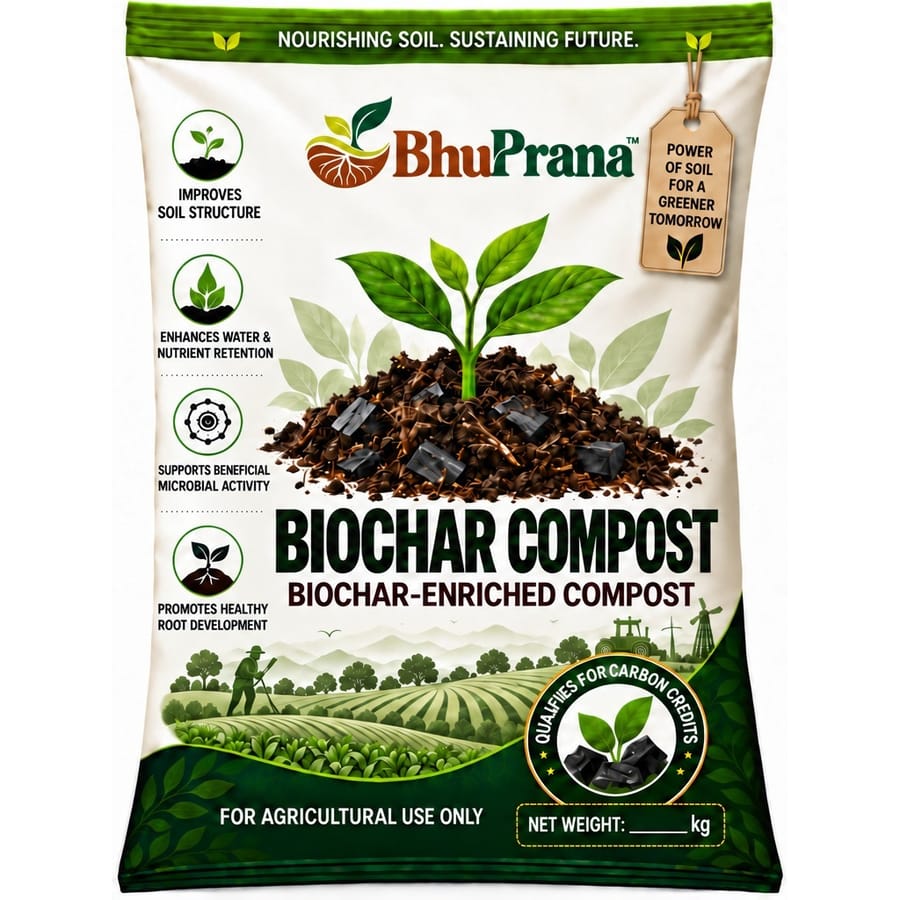
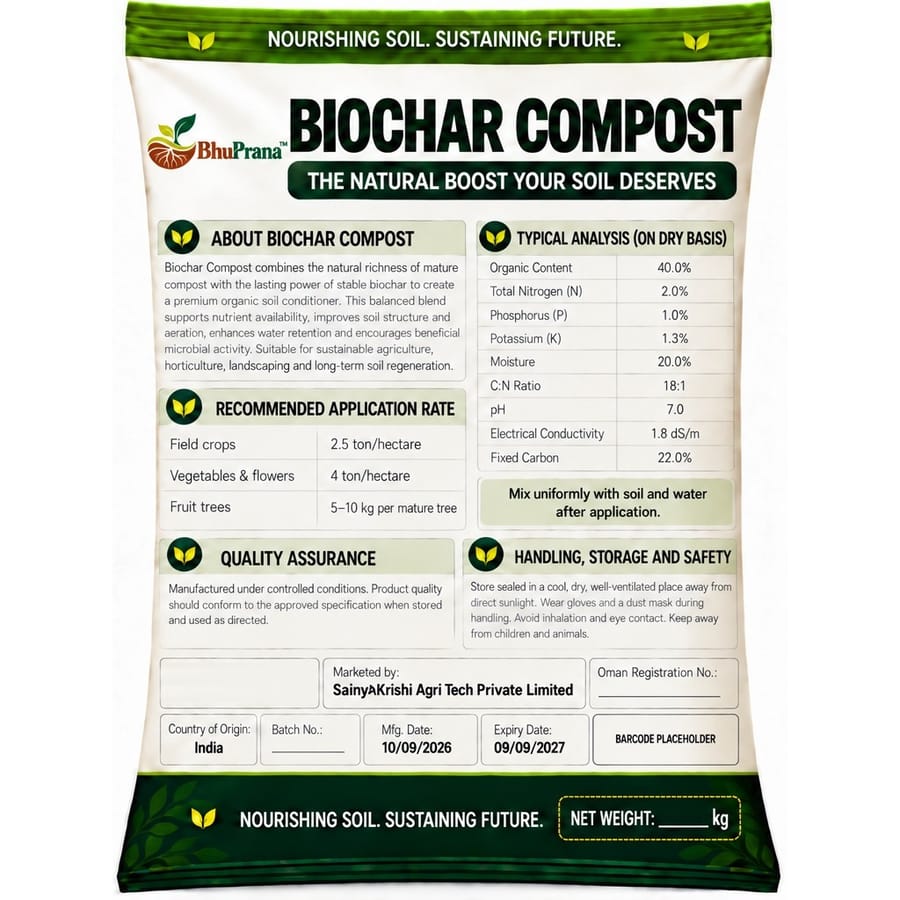
Biochar-Enriched Compost (BEC)
BEC blends premium biochar with vermicompost and a proprietary microbial + micro-nutrient charge in a 1:5 ratio. The result is a living, carbon-rich soil amendment that restores organic carbon, feeds crops and improves structure — applied directly at 2 tons per acre per year.
check_circle Key Benefits
Applications
Industries Served
Specifications
Packaging
Small packs: 1 kg, 2 kg, 5 kg and 10 kg. Bulk supply: 25 kg and 50 kg bags.
Bulk Supply
Volume contracts for FPOs, estates and government projects across India and premium export markets.
What is in a bag of BEC
Biochar-Enriched Compost is our premium graded biochar blended with vermicompost in a 1 : 5 ratio and charged with beneficial microbes and micronutrients. The compost brings readily available nutrients and a living microbial population; the biochar gives that biology a permanent home and holds water and nutrients in the root zone long after the compost itself has broken down.
Because the biochar is charged during blending, BEC does not lock up nutrients the way fresh biochar can. It is ready to apply the day it arrives.
Why blend biochar with compost
Compost alone is a short-lived amendment: most of its carbon is consumed by soil life within a season or two, so it has to be reapplied every year. Biochar alone is long-lived but nutrient-poor. Together they cover each other's gaps. Research on co-composted biochar has found that the organic coating biochar picks up in compost lets it capture nitrate and release it slowly to plants, and that biochar added to composting improves the compost itself by reducing nitrogen losses and odour.
How to apply
The recommended rate is 2 tons per acre per year. For field crops, broadcast BEC evenly and work it into the top 10–15 cm during land preparation, ideally one to two weeks before sowing. For row crops and orchards you can band or ring it around the plant instead, which concentrates the benefit and lowers the quantity needed. For vegetables and nurseries, mix it into beds or potting media.
BEC is a soil amendment, not a complete fertilizer. Use it alongside a nutrient plan based on a soil test; many growers find they can reduce chemical fertilizer as soil organic carbon and water-holding improve over successive seasons.
Which crops benefit most
BEC suits almost every crop, but the gains are usually largest where soils are tired: sandy or red soils that dry out fast, acidic soils, and fields low in organic carbon after years of intensive cropping. Horticulture, vegetables, sugarcane, banana, coconut and arecanut plantations, paddy nurseries, turf and landscaping all use it.
Storage
BEC is a living product. Keep bags in the shade, out of the rain and off wet floors, and use them within a few months of delivery for the best microbial activity. A moisture content of 25–35% is normal; do not let opened bags dry out completely.
Packaging and supply
Small packs of 1, 2, 5 and 10 kg are sold under our BhuPrana brand. Bulk supply ships in 25 kg and 50 kg bags. We run volume contracts for farmer producer organisations, estates, fertilizer companies and government soil-health programmes, with dispatch across India and export to Oman and Sri Lanka.
Sources and further reading
Kammann, C. I., Schmidt, H.-P., Messerschmidt, N. et al. (2015). Plant growth improvement mediated by nitrate capture in co-composted biochar. Scientific Reports 5, 11080.
Hagemann, N., Joseph, S., Schmidt, H.-P. et al. (2017). Organic coating on biochar explains its nutrient retention and stimulation of soil fertility. Nature Communications 8, 1089.
Sanchez-Monedero, M. A., Cayuela, M. L., Roig, A. et al. (2018). Role of biochar as an additive in organic waste composting. Bioresource Technology 247, 1155–1164.
Schmidt, H.-P., Kammann, C., Hagemann, N. et al. (2021). Biochar in agriculture: a systematic review of 26 global meta-analyses. GCB Bioenergy 13, 1708–1730.
Jeffery, S., Abalos, D., Prodana, M. et al. (2017). Biochar boosts tropical but not temperate crop yields. Environmental Research Letters 12, 053001.
Frequently asked questions
What is biochar-enriched compost?
It is compost blended with biochar so that the two work together: the compost supplies nutrients and microbes, the biochar holds water and nutrients in the soil for the long term. Ours is a 1 : 5 blend of biochar and vermicompost, charged with beneficial microbes and micronutrients.
How much BEC should I apply per acre?
The recommended rate is 2 tons per acre per year, worked into the top 10–15 cm before sowing. Banding or ring application around plants can reduce the quantity needed.
Can BEC replace chemical fertilizer?
Not entirely. BEC is a soil amendment that improves how well soil holds and supplies nutrients and water. Many growers reduce fertilizer over time as their soil improves, but nutrient decisions should follow a soil test.
Is BEC suitable for organic farming?
BEC is made from natural inputs: biochar, vermicompost and microbial cultures. If your farm is certified, check with your certification body before using any new input.
How long can I store BEC?
Store it in the shade and keep it from drying out completely. Use it within a few months of delivery for the best microbial activity.